
Intermittent Fasting and Ayurveda: An Ancient View on a Modern Trend
Intermittent Fasting Through the Lens of Ayurveda
Intermittent fasting has taken the modern wellness world by storm. From tech executives to fitness enthusiasts, millions swear by eating windows like the 16:8 method (fasting for 16 hours and eating within an 8-hour window). The promises are alluring: weight loss, clearer thinking, and cellular rejuvenation.
But long before it became a trending topic on social media, fasting was practiced for thousands of years as a core pillar of health. In Ayurveda, the ancient Indian "science of life," fasting is known as Upavasa or Langhana (meaning "to lighten").
While Ayurveda absolutely champions the benefits of giving your digestive system a break, its approach is profoundly different from modern intermittent fasting. Modern fasting often relies on rigid, one-size-fits-all clocks, whereas Ayurveda teaches that fasting must be tailored to your unique mind-body constitution (Doshas) and the strength of your digestive fire (Agni).
Here is a deep dive into how these two worlds intersect, and how you can use ancient Ayurvedic wisdom to make your intermittent fasting routine safer and more effective.
The Heart of Ayurvedic Fasting: Agni and Ama
To understand the Ayurvedic perspective on fasting, you must understand two concepts:
Agni: This is your internal metabolic fire. It is responsible for digesting food, absorbing nutrients, and transforming everything you consume into energy.
Ama: When Agni is weak, food is not properly digested. This creates a toxic, sticky byproduct called Ama, which builds up in the body and can cause fatigue, brain fog, and chronic inflammation.
Ayurveda views fasting as a way to stoke your internal fire. When you stop putting food into your stomach, your Agni doesn't go cold; instead, it turns its attention inward. It begins to burn away the accumulated Ama (toxins), clearing out the metabolic clutter.
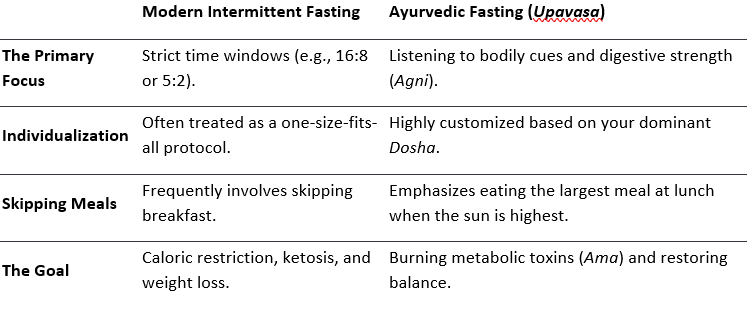
Modern Intermittent Fasting vs. Ayurvedic Upavasa
While modern intermittent fasting focuses almost entirely on when you eat (the clock), Ayurveda focuses heavily on how you feel and who is doing the fasting.
Discover Your Dosha Type In 2 Minutes ➜
Fasting by Your Dosha: Why One Size Does Not Fit All
Ayurveda warns that over-fasting or fasting incorrectly can cause severe imbalances, including dry mouth, skin cracking, and memory impairment. To avoid this, you must fast according to your dominant biological energy, or Dosha:
Vata (Air & Ether): Vata individuals are naturally lean, energetic, and prone to anxiety and dry skin. Because they are already "light" and irregular, extended fasting can severely imbalance Vata, causing racing thoughts, constipation, and poor sleep. If you have a Vata constitution, rigid 16-hour fasts are generally discouraged. Instead, a gentle 12-hour overnight rest (e.g., finishing dinner by 7 PM and eating breakfast at 7 AM) is perfect.
Pitta (Fire & Water): Pitta types have a sharp, intense Agni. When they don't eat, their stomach acid keeps burning, leading to irritability ("hangry" episodes), heartburn, or ulcers. Pitta types can handle mild fasting, but skipping meals entirely can backfire. A gentler 14:10 window usually works better than a strict 16:8 shift.
Kapha (Earth & Water): Kapha individuals have a slow, heavy metabolism and are prone to sluggishness and water retention. Kapha types benefit the most from intermittent fasting. Their bodies are well-equipped to handle the 16:8 window or even occasional full-day juice fasts. Fasting helps kickstart their sluggish digestion and burns through excess weight.
Golden Rules to Take Your Fasting Routine From "Trendy" to "Ayurvedic"
If you want to practice intermittent fasting without burning out your nervous system or disrupting your digestion, keep these Ayurvedic guidelines in mind:
Eat with the Sun: Ayurveda strongly discourages skipping breakfast or eating heavy meals late at night. Your Agni mimics the sun; it is strongest at noon. If you are doing a 16:8 fast, consider an early eating window (e.g., 9:00 AM to 5:00 PM) rather than a late one (1:00 PM to 9:00 PM).
Never Fast to the Point of Exhaustion: You should never feel depleted, dizzy, or painfully hungry while fasting. If you do, your body is telling you that you are depleting your vital life force (Ojas).
Break the Fast Mindfully (Samsarjana Krama): The modern temptation is to break a 16-hour fast with a massive, heavy meal. Ayurveda warns that this crushes your delicate, resting digestive fire. Always break a fast gently—start with a warm, spiced kitchari, a light soup, or warm water with lime before moving to heavier foods.
Listen to Your Body, Not the Clock: If it is 10:00 AM, your eating window doesn't open until noon, but your stomach is growling fiercely and you feel true hunger—eat! Forcing your body to starve overrides its innate intelligence.
The Bottom Line
Intermittent fasting is a beautiful way to cleanse the body, but it is helpful only if it respects your unique biology. Rather than blindly following a timer on an app, use the wisdom of Ayurveda to check in with your body. By aligning your eating windows with your Dosha and the natural rhythm of the sun, you can achieve great results without starving your vitality.
Did you learn something useful? If so, we invite you to explore
the incompatible foods list article or
what food cravings are telling you article.
Discover Your Dosha Type In 2 Minutes ➜
Disclaimer: The information provided across this website, its quiz, and all associated digital products is for educational and holistic lifestyle purposes only. It is not intended to diagnose, treat, cure, or prevent any medical condition, nor should it be used as a substitute for professional medical advice. Always consult with a qualified healthcare provider regarding any health choices or changes to your wellness routine.
Terms & Conditions and Privacy & Cookies Policy
© 2026 My Dosha Type. All rights reserved.